Physics High
  • Home
  • Lessons
    • 1 Foundations >
      • 1.1 Dimensions and units
      • 1.2 Mathematic skills
      • 1.3 Graphing
      • 1.4 Vectors
      • 1.5 Vectors in 3D
    • 2 Mechanics >
      • 2.1 Kinematics 1D >
        • 2.1.1 Kinematics Intro
        • 2.1.2 Acceleration
        • 2.1.3 Graphing Motion
        • 2.1.4 Equations of Motion
      • 2.2 Kinematics 2D >
        • 2.2.1 Relative Motion
        • 2.2.2 Projectile Motion
      • 2.3 Forces >
        • 2.3.1 Newton's Laws
        • 2.3.2 forces in equilibrium
        • 2.3.3 Normal
        • 2.3.4 Friction
        • 2.3.5 Forces and Pulleys
      • 2.4 Momentum and Energy >
        • 2.4.1 Momentum
        • 2.4.2 Energy
      • 2.5 Rotational Mechanics >
        • 2.5.1 Circular Motion
        • 2.5.2 Angular Velocity
        • 2.5.3 Circular applications
        • 2.5.4 Moment of Inertia
        • 2.5.5 Torque
      • 2.6 Gravity >
        • 2.6.1 Gravitation
        • 2.6.2 Orbital Motion
        • 2.6.3 Kepler's Laws
        • 2.6.4 Gravitation and Energy
    • 3 Waves and Optics >
      • 3.1 Wave Phenomena >
        • 3.1.1 Wave Types
        • 3.1.2 Superposition
        • 3.1.3 Interference
        • 3.1.4 Inverse Square Law
        • 3.1.5 Modulation
      • 3.2 Sound >
        • 3.2.1 Beats
        • 3.2.2 Doppler
        • 3.2.3 Resonance
        • 3.2.4 Standing Waves
      • 3.3 Physical Optics >
        • 3.3.1 Light - a history
        • 3.3.2 Double Slit Diffraction
        • 3.3.3 Light - its speed
        • 3.3.4 Light as EMR
        • 3.3.5 Polarisation
        • 3.3.6 Spectroscopy
        • 3.3.7 Scattering
      • 3.4 Geometric Optics >
        • 3.4.1 Reflection
        • 3.4.2 Refraction
        • 3.4.3 Lenses and Images
        • 3.4.4 Dispersion
    • 4 Thermodynamics >
      • 4.1 Heat and Temperature
      • 4.2 Specific Heat Capacity
      • 4.3 Latent Heat
      • 4.4 Blackbody Radiation
    • 5 Electricity and Magnetism >
      • 5.1 Electrostatics >
        • 5.1.1 Charge
        • 5.1.2 Coulomb's Law
        • 5.1.3 Electric Field
        • 5.1.4 Voltage
      • 5.2 Circuits >
        • 5.2.1 Ohm's Law
        • 5.2.2 Series and Parallel Circuits
        • 5.2.3 Electrical Power
      • 5.3 Electromagnetism >
        • 5.3.1 Moving Charges in Electric Fields
        • 5.3.2 Ampere's Law
        • 5.3.3 Charge in Magnetic Fields
        • 5.3.4 Motor Effect
        • 5.3.5 DC Motor
      • 5.4 Electromagnetic Induction >
        • 5.4.1 Magnetic Flux
        • 5.4.2 Faraday's Law
        • 5.4.3 Lenz' Law
        • 5.4.4 Back EMF
        • 5.4.5 Generators
        • 5.4.6 Transformers
        • 5.4.7 Induction Motors
    • 6 Modern Physics >
      • 6.1 Relativity >
        • 6.1.1 Michelson Morley Experiment
        • 6.1.2 Special Relativity
        • 6.1.3 Special Relativity Evidence
      • 6.2 Atomic Physics >
        • 6.2.1 JJ Thomson and the electron
        • 6.2.2 Millikan
        • 6.2.3 Rutherford
        • 6.2.4 Chadwick
      • 6.3 Radioactivity >
        • 6.3.1 What is Radioactivity
        • 6.3.2 Half Life
        • 6.3.3 Binding Energy
        • 6.3.4 Strong Nuclear Force
        • 6.3.5 Fission
        • 6.3.6 Fusion
      • 6.4 Quantum Physics >
        • 6.4.1 Planck and the Blackbody
        • 6.4.2 Photoelectric Effect
        • 6.4.3 Bohr Model
        • 6.4.4 de Broglie and Matter Waves
        • 6.4.5 Compton Effect
        • 6.4.6 Schrödinger Equation
        • 6.4.7 Heisenberg
        • 6.4.8 Lasers
      • 6.4 Particle Physics
      • 6.5 Solid State Physics
    • 7 Astrophysics >
      • 7.1 Olber's Paradox
      • 7.2 Stellar Spectroscopy
      • 7.3 Determining Stellar Distances
      • 7.4 Star Magnitude
      • 7.5 Star Temperature
      • 7..6 HR Diagram
    • 8 Medical Physics >
      • 8.1 Ultrasound
      • 8.2 X-ray
      • 8.3 PET scans
      • 8.4 MRI
  • curriculum specific
    • NSW >
      • NSW curriculum >
        • Year 11
        • Year 12
      • HSC question per Module
      • HSC Exam review >
        • Downloads/notes
    • QLD curriculum
    • IB curriculum
    • SAT curriculum
    • AP Physics 1&2 curriculum
  • Resources
    • Review videos
    • Shorts
    • Formula Sheet
    • tools >
      • Calculator
      • Oscilloscope
    • data sheet
    • for students >
      • recommended physics sites
      • Review and Tips
    • for teachers
    • Blogs >
      • Podcasts
      • PhysicsHigh blog
    • About >
      • Who am I
      • FAQ
      • Fun
      • Contact

Circular Applications

PREVIOUS LESSON                                                                                                                                       NEXT LESSON
In this lesson we will explore a number of applications of circular motion, and where appropriate, examine the applications quantitatively.
We will look at the conical pendulum, banked curves, rollercoaster and some other amusement park rides

The conical pendulum and banked curves

The conical pendulum and banking both are more complex examples of centripetal motion. This video examines these situations. An understanding of the basics of circular motion, normal and friction is assumed.


​A summary on the principles of banked curves, useful for review

Interactive
This is a useful interactive that examines the conical pendulum 

Sample Problems
We are now ready to try some sample problems
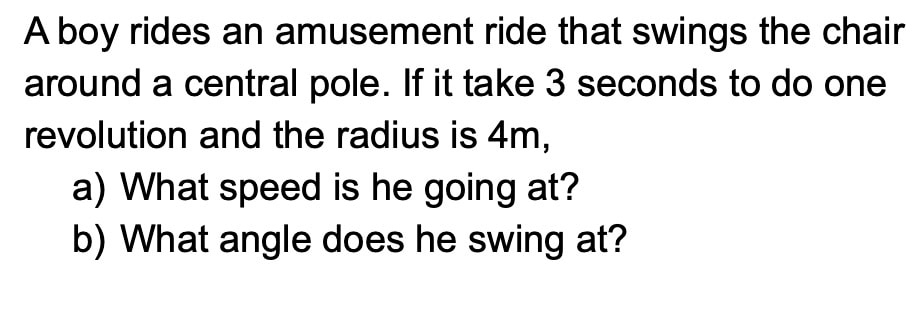
Below is are sample problems with a video that explain how to solve them. It is suggested you try the problems beforehand, as this actually aids understanding, even if you are unsure if you are correct.
Picture
Picture
Some more problems for you to try
1. A car (m = 1500kg) is travelling around a circular corner that has a radius of 20m. If the coefficient of the road surface to the tyres is 0.8.
a. What is the frictional force, the car experience in the turn?
b. What is the maximum speed that car can travel around the curve?
c. As it goes into the turn, it encounters a wet section that reduces μ to 0.5. Explain what happens to the car?


2. You are in a roller coaster that is approaching a circular loop, that has a diameter. Of 60m. You forgot to buckle in. What speed must you enter to to ensure you don't fall out (HINT: Apart from circular motion, you also need to consider conservation of energy, and assume negligible loss of energy due to friction)

3. A pendulum is rotating with a frequency of 1.5 Hz with a radius of 5 cm, as shown to the right. What is the angle?


4. A 70 tonne 737 makes a banking turn to come into land. If the radius is 2km and its speed is 300km/h a. What will be its banking angle? b. What would be the force it experiences to painting this turn (ie the Normal)


Rollercoasters and looped tracks


Roller coasters provide a great way to examine physics concepts: everything from forces, momentum, and energy - from both a linear perspective and rotational.
This covers these concepts and is here since loops are examined.
Many motion graph analysis video examine simplistic examples where velocity is constant or acceleration is constant.

​In this video I analyse a well known toy which has more complex motion, and I apply the same skills taught to analyse its graph. This video helps students consolidate their understanding of motion graphs, as well as review concepts such as friction, energy and forces.
Quiz to test your understanding
PREVIOUS LESSON                                                                                                                                       NEXT LESSON

Support

About
Contact
FAQ
Terms of Use
Picture
© COPYRIGHT 2024.
​ALL RIGHTS RESERVED.
  • Home
  • Lessons
    • 1 Foundations >
      • 1.1 Dimensions and units
      • 1.2 Mathematic skills
      • 1.3 Graphing
      • 1.4 Vectors
      • 1.5 Vectors in 3D
    • 2 Mechanics >
      • 2.1 Kinematics 1D >
        • 2.1.1 Kinematics Intro
        • 2.1.2 Acceleration
        • 2.1.3 Graphing Motion
        • 2.1.4 Equations of Motion
      • 2.2 Kinematics 2D >
        • 2.2.1 Relative Motion
        • 2.2.2 Projectile Motion
      • 2.3 Forces >
        • 2.3.1 Newton's Laws
        • 2.3.2 forces in equilibrium
        • 2.3.3 Normal
        • 2.3.4 Friction
        • 2.3.5 Forces and Pulleys
      • 2.4 Momentum and Energy >
        • 2.4.1 Momentum
        • 2.4.2 Energy
      • 2.5 Rotational Mechanics >
        • 2.5.1 Circular Motion
        • 2.5.2 Angular Velocity
        • 2.5.3 Circular applications
        • 2.5.4 Moment of Inertia
        • 2.5.5 Torque
      • 2.6 Gravity >
        • 2.6.1 Gravitation
        • 2.6.2 Orbital Motion
        • 2.6.3 Kepler's Laws
        • 2.6.4 Gravitation and Energy
    • 3 Waves and Optics >
      • 3.1 Wave Phenomena >
        • 3.1.1 Wave Types
        • 3.1.2 Superposition
        • 3.1.3 Interference
        • 3.1.4 Inverse Square Law
        • 3.1.5 Modulation
      • 3.2 Sound >
        • 3.2.1 Beats
        • 3.2.2 Doppler
        • 3.2.3 Resonance
        • 3.2.4 Standing Waves
      • 3.3 Physical Optics >
        • 3.3.1 Light - a history
        • 3.3.2 Double Slit Diffraction
        • 3.3.3 Light - its speed
        • 3.3.4 Light as EMR
        • 3.3.5 Polarisation
        • 3.3.6 Spectroscopy
        • 3.3.7 Scattering
      • 3.4 Geometric Optics >
        • 3.4.1 Reflection
        • 3.4.2 Refraction
        • 3.4.3 Lenses and Images
        • 3.4.4 Dispersion
    • 4 Thermodynamics >
      • 4.1 Heat and Temperature
      • 4.2 Specific Heat Capacity
      • 4.3 Latent Heat
      • 4.4 Blackbody Radiation
    • 5 Electricity and Magnetism >
      • 5.1 Electrostatics >
        • 5.1.1 Charge
        • 5.1.2 Coulomb's Law
        • 5.1.3 Electric Field
        • 5.1.4 Voltage
      • 5.2 Circuits >
        • 5.2.1 Ohm's Law
        • 5.2.2 Series and Parallel Circuits
        • 5.2.3 Electrical Power
      • 5.3 Electromagnetism >
        • 5.3.1 Moving Charges in Electric Fields
        • 5.3.2 Ampere's Law
        • 5.3.3 Charge in Magnetic Fields
        • 5.3.4 Motor Effect
        • 5.3.5 DC Motor
      • 5.4 Electromagnetic Induction >
        • 5.4.1 Magnetic Flux
        • 5.4.2 Faraday's Law
        • 5.4.3 Lenz' Law
        • 5.4.4 Back EMF
        • 5.4.5 Generators
        • 5.4.6 Transformers
        • 5.4.7 Induction Motors
    • 6 Modern Physics >
      • 6.1 Relativity >
        • 6.1.1 Michelson Morley Experiment
        • 6.1.2 Special Relativity
        • 6.1.3 Special Relativity Evidence
      • 6.2 Atomic Physics >
        • 6.2.1 JJ Thomson and the electron
        • 6.2.2 Millikan
        • 6.2.3 Rutherford
        • 6.2.4 Chadwick
      • 6.3 Radioactivity >
        • 6.3.1 What is Radioactivity
        • 6.3.2 Half Life
        • 6.3.3 Binding Energy
        • 6.3.4 Strong Nuclear Force
        • 6.3.5 Fission
        • 6.3.6 Fusion
      • 6.4 Quantum Physics >
        • 6.4.1 Planck and the Blackbody
        • 6.4.2 Photoelectric Effect
        • 6.4.3 Bohr Model
        • 6.4.4 de Broglie and Matter Waves
        • 6.4.5 Compton Effect
        • 6.4.6 Schrödinger Equation
        • 6.4.7 Heisenberg
        • 6.4.8 Lasers
      • 6.4 Particle Physics
      • 6.5 Solid State Physics
    • 7 Astrophysics >
      • 7.1 Olber's Paradox
      • 7.2 Stellar Spectroscopy
      • 7.3 Determining Stellar Distances
      • 7.4 Star Magnitude
      • 7.5 Star Temperature
      • 7..6 HR Diagram
    • 8 Medical Physics >
      • 8.1 Ultrasound
      • 8.2 X-ray
      • 8.3 PET scans
      • 8.4 MRI
  • curriculum specific
    • NSW >
      • NSW curriculum >
        • Year 11
        • Year 12
      • HSC question per Module
      • HSC Exam review >
        • Downloads/notes
    • QLD curriculum
    • IB curriculum
    • SAT curriculum
    • AP Physics 1&2 curriculum
  • Resources
    • Review videos
    • Shorts
    • Formula Sheet
    • tools >
      • Calculator
      • Oscilloscope
    • data sheet
    • for students >
      • recommended physics sites
      • Review and Tips
    • for teachers
    • Blogs >
      • Podcasts
      • PhysicsHigh blog
    • About >
      • Who am I
      • FAQ
      • Fun
      • Contact