Physics High
  • Home
  • Lessons
    • 1 Foundations >
      • 1.1 Dimensions and units
      • 1.2 Mathematic skills
      • 1.3 Graphing
      • 1.4 Vectors
      • 1.5 Vectors in 3D
    • 2 Mechanics >
      • 2.1 Kinematics 1D >
        • 2.1.1 Kinematics Intro
        • 2.1.2 Acceleration
        • 2.1.3 Graphing Motion
        • 2.1.4 Equations of Motion
      • 2.2 Kinematics 2D >
        • 2.2.1 Relative Motion
        • 2.2.2 Projectile Motion
      • 2.3 Forces >
        • 2.3.1 Newton's Laws
        • 2.3.2 forces in equilibrium
        • 2.3.3 Normal
        • 2.3.4 Friction
        • 2.3.5 Forces and Pulleys
      • 2.4 Momentum and Energy >
        • 2.4.1 Momentum
        • 2.4.2 Energy
      • 2.5 Rotational Mechanics >
        • 2.5.1 Circular Motion
        • 2.5.2 Angular Velocity
        • 2.5.3 Circular applications
        • 2.5.4 Moment of Inertia
        • 2.5.5 Torque
      • 2.6 Gravity >
        • 2.6.1 Gravitation
        • 2.6.2 Orbital Motion
        • 2.6.3 Kepler's Laws
        • 2.6.4 Gravitation and Energy
    • 3 Waves and Optics >
      • 3.1 Wave Phenomena >
        • 3.1.1 Wave Types
        • 3.1.2 Superposition
        • 3.1.3 Interference
        • 3.1.4 Inverse Square Law
        • 3.1.5 Modulation
      • 3.2 Sound >
        • 3.2.1 Beats
        • 3.2.2 Doppler
        • 3.2.3 Resonance
        • 3.2.4 Standing Waves
      • 3.3 Physical Optics >
        • 3.3.1 Light - a history
        • 3.3.2 Double Slit Diffraction
        • 3.3.3 Light - its speed
        • 3.3.4 Light as EMR
        • 3.3.5 Polarisation
        • 3.3.6 Spectroscopy
        • 3.3.7 Scattering
      • 3.4 Geometric Optics >
        • 3.4.1 Reflection
        • 3.4.2 Refraction
        • 3.4.3 Lenses and Images
        • 3.4.4 Dispersion
    • 4 Thermodynamics >
      • 4.1 Heat and Temperature
      • 4.2 Specific Heat Capacity
      • 4.3 Latent Heat
      • 4.4 Blackbody Radiation
    • 5 Electricity and Magnetism >
      • 5.1 Electrostatics >
        • 5.1.1 Charge
        • 5.1.2 Coulomb's Law
        • 5.1.3 Electric Field
        • 5.1.4 Voltage
      • 5.2 Circuits >
        • 5.2.1 Ohm's Law
        • 5.2.2 Series and Parallel Circuits
        • 5.2.3 Electrical Power
      • 5.3 Electromagnetism >
        • 5.3.1 Moving Charges in Electric Fields
        • 5.3.2 Ampere's Law
        • 5.3.3 Charge in Magnetic Fields
        • 5.3.4 Motor Effect
        • 5.3.5 DC Motor
      • 5.4 Electromagnetic Induction >
        • 5.4.1 Magnetic Flux
        • 5.4.2 Faraday's Law
        • 5.4.3 Lenz' Law
        • 5.4.4 Back EMF
        • 5.4.5 Generators
        • 5.4.6 Transformers
        • 5.4.7 Induction Motors
    • 6 Modern Physics >
      • 6.1 Relativity >
        • 6.1.1 Michelson Morley Experiment
        • 6.1.2 Special Relativity
        • 6.1.3 Special Relativity Evidence
      • 6.2 Atomic Physics >
        • 6.2.1 JJ Thomson and the electron
        • 6.2.2 Millikan
        • 6.2.3 Rutherford
        • 6.2.4 Chadwick
      • 6.3 Radioactivity >
        • 6.3.1 What is Radioactivity
        • 6.3.2 Half Life
        • 6.3.3 Binding Energy
        • 6.3.4 Strong Nuclear Force
        • 6.3.5 Fission
        • 6.3.6 Fusion
      • 6.4 Quantum Physics >
        • 6.4.1 Planck and the Blackbody
        • 6.4.2 Photoelectric Effect
        • 6.4.3 Bohr Model
        • 6.4.4 de Broglie and Matter Waves
        • 6.4.5 Compton Effect
        • 6.4.6 Schrödinger Equation
        • 6.4.7 Heisenberg
        • 6.4.8 Lasers
      • 6.4 Particle Physics
      • 6.5 Solid State Physics
    • 7 Astrophysics >
      • 7.1 Olber's Paradox
      • 7.2 Stellar Spectroscopy
      • 7.3 Determining Stellar Distances
      • 7.4 Star Magnitude
      • 7.5 Star Temperature
      • 7..6 HR Diagram
    • 8 Medical Physics >
      • 8.1 Ultrasound
      • 8.2 X-ray
      • 8.3 PET scans
      • 8.4 MRI
  • curriculum specific
    • NSW >
      • NSW curriculum >
        • Year 11
        • Year 12
      • HSC question per Module
      • HSC Exam review >
        • Downloads/notes
    • QLD curriculum
    • IB curriculum
    • SAT curriculum
    • AP Physics 1&2 curriculum
  • Resources
    • Review videos
    • Shorts
    • Formula Sheet
    • tools >
      • Calculator
      • Oscilloscope
    • data sheet
    • for students >
      • recommended physics sites
      • Review and Tips
    • for teachers
    • Blogs >
      • Podcasts
      • PhysicsHigh blog
    • About >
      • Who am I
      • FAQ
      • Fun
      • Contact

Equations of Motion

PREVIOUS LESSON                                                                                                                                       NEXT LESSON
 
In the previous lesson we looks at graphing motion.
If motion can be graphed and there are certain trends, then there are mathematical equation that describe that trend.

In this lesson we examine these mathematical equations.
​
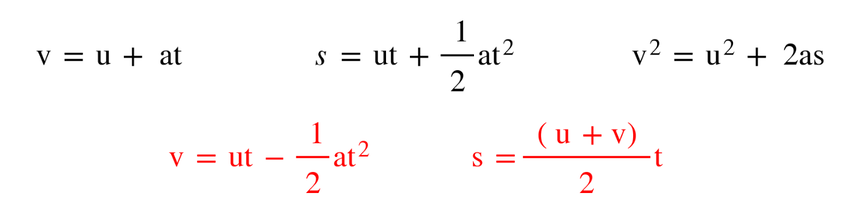
There are relationships between each of the variables involved in kinematics and these mathematical relationships are modelled in what are know as the kinematic equations, or equations of motion. 
Picture
though the two in red are less commonly used
​Theory
Watch the video which covers the 5 forms of kinematic equations and how they are derived.

​

How to Solve physics Problems
Before we look at a sample problem, there is a useful technique to use consistently when doing calculation type problems and it requires you to be RUDE.
​Read Understand Data Equation.
Watch the video as I explain

Sample Problem
We are now ready to try a sample problem
Below is a sample problem with a video that explain how to solve it. It is suggested you try the problem beforehand, as this actually aids understanding, even if you are unsure if you are correct.

Picture

Here are some more problems for you to try. Answers are provided. 

  1. A car travels 20 km at 40 kmh-1. What speed should the car at the next 20 km to have an average speed of 60 kmh-1 for the whole journey?  (120 kmh-1) 
  2. A car leaves home at 8 am and travels at 60 kmh-1. Another car leaves the same home at 8:30 am and  was at 80 kmh-1. When and where will the second car overtake the first car? (10am, 120km) 
  3. An aircraft needs to reach a speed of 80 ms-1 before it can take off. If it accelerates at 3  ms-2 , calculate the length of the run by used. (1070m) 
  4. An object moving with a constant acceleration can certainly slow down. But can an object ever come to a permanent halt if it’s acceleration truly remains constant? Explain. 
  5. A car with its brakes full on decelerates at 4  ms-2. If the car is moving uniformly at 20  ms-1 when a cow crosses 60 m in front of it, and if it takes a car six seconds to come to rest, calculate how long it took the driver to apply the brakes. Does it hit the cow? (1 sec, yes they hit the cow)
GOING FURTHER

Determing the equations of motion using graphical Analysis or algebraically are not the only way to derive them.
A more powerful way is too use calculus


​In this video, using both differential and integral calculus, I show how the equations of motion are derived.
PREVIOUS LESSON                                                                                                                                       NEXT LESSON

Support

About
Contact
FAQ
Terms of Use
Picture
© COPYRIGHT 2024.
​ALL RIGHTS RESERVED.
  • Home
  • Lessons
    • 1 Foundations >
      • 1.1 Dimensions and units
      • 1.2 Mathematic skills
      • 1.3 Graphing
      • 1.4 Vectors
      • 1.5 Vectors in 3D
    • 2 Mechanics >
      • 2.1 Kinematics 1D >
        • 2.1.1 Kinematics Intro
        • 2.1.2 Acceleration
        • 2.1.3 Graphing Motion
        • 2.1.4 Equations of Motion
      • 2.2 Kinematics 2D >
        • 2.2.1 Relative Motion
        • 2.2.2 Projectile Motion
      • 2.3 Forces >
        • 2.3.1 Newton's Laws
        • 2.3.2 forces in equilibrium
        • 2.3.3 Normal
        • 2.3.4 Friction
        • 2.3.5 Forces and Pulleys
      • 2.4 Momentum and Energy >
        • 2.4.1 Momentum
        • 2.4.2 Energy
      • 2.5 Rotational Mechanics >
        • 2.5.1 Circular Motion
        • 2.5.2 Angular Velocity
        • 2.5.3 Circular applications
        • 2.5.4 Moment of Inertia
        • 2.5.5 Torque
      • 2.6 Gravity >
        • 2.6.1 Gravitation
        • 2.6.2 Orbital Motion
        • 2.6.3 Kepler's Laws
        • 2.6.4 Gravitation and Energy
    • 3 Waves and Optics >
      • 3.1 Wave Phenomena >
        • 3.1.1 Wave Types
        • 3.1.2 Superposition
        • 3.1.3 Interference
        • 3.1.4 Inverse Square Law
        • 3.1.5 Modulation
      • 3.2 Sound >
        • 3.2.1 Beats
        • 3.2.2 Doppler
        • 3.2.3 Resonance
        • 3.2.4 Standing Waves
      • 3.3 Physical Optics >
        • 3.3.1 Light - a history
        • 3.3.2 Double Slit Diffraction
        • 3.3.3 Light - its speed
        • 3.3.4 Light as EMR
        • 3.3.5 Polarisation
        • 3.3.6 Spectroscopy
        • 3.3.7 Scattering
      • 3.4 Geometric Optics >
        • 3.4.1 Reflection
        • 3.4.2 Refraction
        • 3.4.3 Lenses and Images
        • 3.4.4 Dispersion
    • 4 Thermodynamics >
      • 4.1 Heat and Temperature
      • 4.2 Specific Heat Capacity
      • 4.3 Latent Heat
      • 4.4 Blackbody Radiation
    • 5 Electricity and Magnetism >
      • 5.1 Electrostatics >
        • 5.1.1 Charge
        • 5.1.2 Coulomb's Law
        • 5.1.3 Electric Field
        • 5.1.4 Voltage
      • 5.2 Circuits >
        • 5.2.1 Ohm's Law
        • 5.2.2 Series and Parallel Circuits
        • 5.2.3 Electrical Power
      • 5.3 Electromagnetism >
        • 5.3.1 Moving Charges in Electric Fields
        • 5.3.2 Ampere's Law
        • 5.3.3 Charge in Magnetic Fields
        • 5.3.4 Motor Effect
        • 5.3.5 DC Motor
      • 5.4 Electromagnetic Induction >
        • 5.4.1 Magnetic Flux
        • 5.4.2 Faraday's Law
        • 5.4.3 Lenz' Law
        • 5.4.4 Back EMF
        • 5.4.5 Generators
        • 5.4.6 Transformers
        • 5.4.7 Induction Motors
    • 6 Modern Physics >
      • 6.1 Relativity >
        • 6.1.1 Michelson Morley Experiment
        • 6.1.2 Special Relativity
        • 6.1.3 Special Relativity Evidence
      • 6.2 Atomic Physics >
        • 6.2.1 JJ Thomson and the electron
        • 6.2.2 Millikan
        • 6.2.3 Rutherford
        • 6.2.4 Chadwick
      • 6.3 Radioactivity >
        • 6.3.1 What is Radioactivity
        • 6.3.2 Half Life
        • 6.3.3 Binding Energy
        • 6.3.4 Strong Nuclear Force
        • 6.3.5 Fission
        • 6.3.6 Fusion
      • 6.4 Quantum Physics >
        • 6.4.1 Planck and the Blackbody
        • 6.4.2 Photoelectric Effect
        • 6.4.3 Bohr Model
        • 6.4.4 de Broglie and Matter Waves
        • 6.4.5 Compton Effect
        • 6.4.6 Schrödinger Equation
        • 6.4.7 Heisenberg
        • 6.4.8 Lasers
      • 6.4 Particle Physics
      • 6.5 Solid State Physics
    • 7 Astrophysics >
      • 7.1 Olber's Paradox
      • 7.2 Stellar Spectroscopy
      • 7.3 Determining Stellar Distances
      • 7.4 Star Magnitude
      • 7.5 Star Temperature
      • 7..6 HR Diagram
    • 8 Medical Physics >
      • 8.1 Ultrasound
      • 8.2 X-ray
      • 8.3 PET scans
      • 8.4 MRI
  • curriculum specific
    • NSW >
      • NSW curriculum >
        • Year 11
        • Year 12
      • HSC question per Module
      • HSC Exam review >
        • Downloads/notes
    • QLD curriculum
    • IB curriculum
    • SAT curriculum
    • AP Physics 1&2 curriculum
  • Resources
    • Review videos
    • Shorts
    • Formula Sheet
    • tools >
      • Calculator
      • Oscilloscope
    • data sheet
    • for students >
      • recommended physics sites
      • Review and Tips
    • for teachers
    • Blogs >
      • Podcasts
      • PhysicsHigh blog
    • About >
      • Who am I
      • FAQ
      • Fun
      • Contact